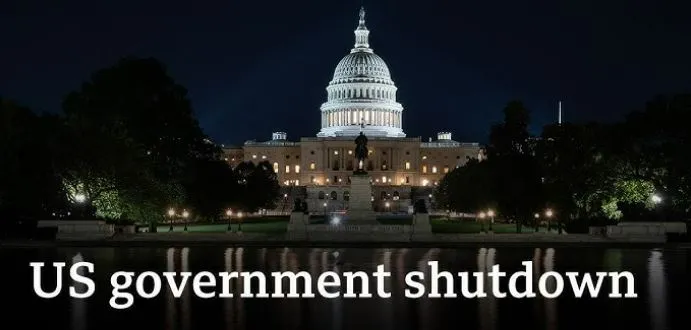
A U.S. government shutdown happens when the federal government runs out of funding because Congress fails to pass the necessary spending bills or a temporary funding measure (called a continuing resolution).
What is a U.S. shutdown?
-
The U.S. government operates on a budget year (Oct 1 – Sept 30).
-
Congress (House + Senate) must pass spending bills, and the President must sign them to keep federal agencies running.
-
If no agreement is reached, many government operations stop — this is called a shutdown.
Why does it happen?
-
Budget Disagreements – Congress and the President can’t agree on how much money to spend and on what programs (e.g., defense, healthcare, immigration, etc.).
-
Political Deadlock – Sometimes one party uses the shutdown threat as leverage to push certain policies.
-
Debt & Deficit Issues – Disputes over how much the U.S. should borrow or spend.
What happens during a shutdown?
-
Essential services (like military, air traffic control, border security, Social Security checks, Medicare) continue.
-
Non-essential services (like national parks, some federal offices, visa/passport processing, research funding, IRS help desks) close or slow down.
-
Federal employees:
-
“Essential” workers still work but without immediate pay (they get back pay later).
-
“Non-essential” workers are furloughed (temporary unpaid leave).
-
Any government changes during a shutdown?
-
No leadership change happens directly because of a shutdown.
-
The President, Congress, and Supreme Court remain in place.
-
It is a funding lapse, not a change of government.
-
But politically, shutdowns can damage the reputation of whichever party is blamed, sometimes influencing elections later.
Government Shutdown vs. Debt Ceiling Crisis
1. Government Shutdown
-
Cause: Congress fails to pass spending bills or a temporary funding resolution.
-
Effect: Many parts of the government close temporarily (national parks, federal offices, etc.), while essential services continue.
-
Impact: Federal employees furloughed, delays in services, economic slowdown.
-
Key Point: It’s about how to spend money for the next year.
2. Debt Ceiling Crisis
-
Cause: The U.S. has a legal borrowing limit called the debt ceiling (set by Congress).
-
When government spending exceeds tax revenues, the U.S. Treasury borrows money to pay existing obligations (like Social Security, military salaries, debt interest).
-
If Congress doesn’t raise or suspend the debt ceiling, the government can’t borrow more → it risks defaulting on its payments.
-
Impact: Much more dangerous than a shutdown. A default could:
-
Shatter global confidence in the U.S. dollar.
-
Spike interest rates worldwide.
-
Trigger a financial crisis.
-
- Key Point: It’s about paying past obligations, not new spending.
| Aspect | Shutdown | Debt Ceiling Crisis |
|---|---|---|
| What’s at stake? | Annual budget/funding | Ability to pay existing debts |
| Triggered by | Failure to pass spending bills | Failure to raise borrowing limit |
| Immediate effect | Government services stop | U.S. runs out of cash |
| Severity | Serious but temporary | Potentially catastrophic (global impact) |
Major U.S. Shutdowns in Recent History
1. 2018–2019 Shutdown
-
Duration: 35 days (Dec 22, 2018 – Jan 25, 2019) → Longest in U.S. history
-
President: Donald Trump
-
Reason: Dispute over funding for U.S.-Mexico border wall.
-
Impact:
-
800,000 federal workers furloughed or worked without pay.
-
Delays in air travel, closed national parks, slowed tax refunds.
-
Estimated economic loss: ~$11 billion.
-
2. 2013 Shutdown
-
Duration: 16 days (Oct 1 – Oct 17, 2013)
-
President: Barack Obama
-
Reason: House Republicans demanded to defund or delay Obamacare (Affordable Care Act) in budget talks.
-
Impact:
-
About 850,000 federal workers furloughed.
-
National parks and monuments closed.
-
Cost: ~$24 billion to U.S. economy.
-
3. 1995–1996 Shutdowns (two back-to-back)
-
Duration:
-
21 days (Dec 16, 1995 – Jan 6, 1996)
-
5 days (Nov 14 – Nov 19, 1995)
-
-
President: Bill Clinton
-
Reason: Budget battle with House Speaker Newt Gingrich (Republicans wanted bigger spending cuts).
-
Impact:
-
Hundreds of thousands of federal workers furloughed.
-
Museums, national parks, passport processing all closed.
-
Clinton’s popularity rose after the shutdown, hurting Republicans politically.
-
4. 1990 Shutdown
-
Duration: 3 days (Oct 5 – Oct 9, 1990)
-
President: George H.W. Bush
-
Reason: Disagreement over a deficit-reduction plan that included tax increases.
-
Impact: 800,000 federal workers furloughed.
5. Other smaller shutdowns
-
1981, 1984, 1986, 1990s saw a few shorter shutdowns, often lasting just 1–3 days.
-
Causes were usually budget disputes, social program funding, or defense spending levels.
- On October 1, 2025, The federal government shutdown after lawmakers failed to pass a funding bill. The agencies and departments each have their own operational procedures during a shutdown, and they have issued guidance about what to expect as the money runs out. The shutdown resulted from partisan disagreements over federal spending levels, foreign aid rescissions, and health insurance subsidies.
The shutdown resulted in the furlough of roughly 800,000 federal employees and left another 700,000 working without pay. Federal departments and agencies have put out guidance about which programs will stay open and which ones won’t during the funding lapse.
How a U.S. Shutdown Affects Other Countries
1. Global Financial Markets
-
Investors worldwide closely watch the U.S. economy.
-
Shutdown = signals political dysfunction in Washington → this can cause:
-
Stock market volatility in the U.S. and abroad.
-
Investors moving money into “safe assets” (like gold, Japanese yen, or Swiss franc).
-
A temporary dip in confidence in the U.S. dollar.
-
2. Trade & Business
-
U.S. is a major trading partner for many nations.
-
During shutdowns:
-
Some export/import approvals (like agricultural inspections, food safety checks) may slow.
-
Visa and customs delays can affect business travel and trade shipments.
-
-
Example: In 2019 shutdown, Canadian exporters faced delays in shipping goods into the U.S.
3. Tourism
-
Closure of U.S. national parks, monuments, and museums hurts not only American tourism but also international travelers who planned visits.
-
Foreign travel businesses depending on U.S. tourism (like hotels, airlines, travel agencies) lose money.
4. Global Economy Confidence
-
A shutdown itself doesn’t stop the U.S. from paying debt (that’s the debt ceiling crisis), but prolonged shutdowns show political instability.
-
Other countries’ governments and investors may worry about U.S. reliability as an economic leader.
5. Research & International Cooperation
-
Many U.S. government-backed scientific projects, space missions (NASA), and international research partnerships pause.
-
This slows progress for global projects that rely on U.S. cooperation.
Key Takeaways
-
Shutdowns are always about Congress vs. President disputes over budget priorities.
-
They don’t change the government structure, but they disrupt everyday services and cost billions.
-
Politically, shutdowns can backfire — often the party seen as “causing” it loses public support.