The CISSP course and certification has become the golden ticket in cybersecurity careers, with certified professionals earning an average of $131,030 annually. That’s $15,000 more than their non-certified counterparts.
Getting your CISSP certification is like joining an exclusive club where the membership card opens doors to senior security positions across industries. The right CISSP course doesn’t just prepare you for the exam—it transforms how you think about security architecture, management, and implementation.
But here’s what nobody tells you about CISSP preparation that makes all the difference between passing and failing
Understanding the CISSP Certification Value
What is CISSP and why it matters in cybersecurity?
The Certified Information Systems Security Professional (CISSP) isn’t just another certification to add to your resume—it’s the gold standard in the cybersecurity world. Developed by (ISC)², CISSP validates your expertise across eight critical security domains, from security and risk management to software development security.
Think of CISSP as your cybersecurity passport. It proves you can design, implement, and manage a best-in-class cybersecurity program. And in a world where cyber threats evolve hourly? That’s incredibly valuable.
What makes CISSP stand out is its holistic approach. While other certs might focus on specific technical skills, CISSP forces you to think like a security leader. You’re not just learning how to configure firewalls—you’re understanding how security decisions impact the entire business.
Companies take notice too. When major breaches hit the headlines weekly, organizations desperately need professionals who can see the big picture. A CISSP on your team signals that you’ve got someone who understands both the technical nitty-gritty and the executive-level concerns.
The certification also requires five years of paid work experience in at least two security domains. This isn’t something you can cram for over a weekend—it represents real-world expertise.
Career advancement opportunities with CISSP credentials
Got your CISSP? Congratulations—you’ve just unlocked multiple career paths. This certification is often the difference between staying in the technical trenches and moving into leadership.
Many CISSP holders find themselves fast-tracked into roles like:
- Information Security Manager
- Chief Information Security Officer (CISO)
- Security Architect
- Security Consultant
- Security Analyst (Senior level)
- IT Director
The beauty of CISSP is its versatility. Whether you want to specialize in governance, cloud security, or penetration testing, this certification gives you credibility across domains.
I’ve seen countless professionals break through career plateaus after earning their CISSP. One minute they’re stuck as mid-level analysts, the next they’re being considered for director positions. Why? Because CISSP demonstrates both technical knowledge and management potential.
It’s also a ticket to job stability. Even during economic downturns, CISSP-certified professionals tend to maintain employment. Organizations view them as essential personnel—not optional expenses to cut when budgets tighten.
Another overlooked benefit: CISSP opens doors internationally. It’s recognized in virtually every major market, making it valuable for professionals looking to work abroad or with global companies.
Average salary increases for CISSP-certified professionals
Show me the money! That’s what most professionals want to know before investing in a challenging certification like CISSP. The numbers don’t disappoint.
As of 2025, CISSP holders consistently earn 25-30% more than their non-certified counterparts in similar roles. Let’s break down some real figures:
| Position | Without CISSP | With CISSP | Difference |
| Security Analyst | $95,000 | $120,000 | +$25,000 |
| Security Engineer | $110,000 | $140,000 | +$30,000 |
| Security Architect | $125,000 | $160,000 | +$35,000 |
| Security Manager | $130,000 | $165,000 | +$35,000 |
| CISO | $175,000 | $210,000+ | +$35,000+ |
These salary bumps aren’t just in major tech hubs like Silicon Valley or New York. Even in smaller markets, the CISSP premium holds steady.
The ROI is clear: The certification costs around $749 (exam fee) plus preparation expenses, but typically pays for itself within months through salary increases or new job opportunities.
Bonus: Many CISSP professionals report additional compensation through consulting gigs, speaking engagements, and training opportunities that wouldn’t be available without the certification.
How CISSP compares to other security certifications
The cybersecurity certification landscape is crowded. So why does CISSP continue to reign supreme? Let’s compare it with other popular certifications:
CISSP vs. CompTIA Security+:
Security+ is an entry-level certification perfect for beginners. CISSP is more advanced, requiring years of experience and covering management aspects. Think of Security+ as your first apartment and CISSP as your dream house—both serve a purpose, but at different career stages.
CISSP vs. CEH (Certified Ethical Hacker):
CEH focuses specifically on offensive security and penetration testing. CISSP is broader, covering defensive strategies, governance, and compliance. Many professionals actually hold both, using CEH for technical specialization and CISSP for overall security management.
CISSP vs. CISM (Certified Information Security Manager):
These certifications are often confused because both target management roles. The key difference? CISM is heavily focused on governance and program management, while CISSP maintains a technical foundation alongside management principles.
What sets CISSP apart is its longevity and industry respect. While newer certifications come and go, CISSP has maintained its status for over 25 years. It’s also vendor-neutral, focusing on principles rather than specific technologies that might become obsolete.
The certification’s continuous professional education requirement ensures CISSP holders stay current—another reason employers value it above many alternatives.
CISSP Exam Requirements and Prerequisites
The Certified Information Systems Security Professional (CISSP) is a globally recognized certification in the field of information security. Offered by (ISC)², it validates a professional’s expertise in designing, implementing, and managing a best-in-class cybersecurity program.
Work Experience Requirements
To become fully certified, candidates must have:
- At least 5 years of cumulative, paid work experience in 2 or more of the 8 CISSP domains from the (ISC)² CISSP Common Body of Knowledge (CBK).
CISSP Domains:
- Security and Risk Management
- Asset Security
- Security Architecture and Engineering
- Communication and Network Security
- Identity and Access Management (IAM)
- Security Assessment and Testing
- Security Operations
- Software Development Security
Experience Waiver:
- You can waive 1 year of the required 5 years if you:
- Hold a four-year college degree, or
- Have an (ISC)² approved credential like CompTIA Security+, CISM, CEH, etc.
✅ This means you can qualify with 4 years of experience plus a waiver.
✅ 2. No Experience? Become an Associate of (ISC)²
If you don’t yet have the required experience:
- You can take and pass the CISSP exam and become an Associate of (ISC)².
- Then, you’ll have up to 6 years to gain the required experience.
✅ 3. Endorsement Process
After passing the exam, you must:
- Be endorsed by another (ISC)² certified professional.
- The endorser verifies your professional experience.
- You have 9 months from the exam date to complete this.
✅ 4. Code of Ethics
All candidates must agree to and uphold the (ISC)² Code of Ethics.
✅ 5. Exam Details
- Format: Computer-based (CAT format)
- Questions: 100–150 multiple-choice and advanced innovative questions
- Duration: 3 hours
- Passing Score: 700 out of 1000
- Locations: Pearson VUE test centers worldwide
✅ 6. Continuing Professional Education (CPE)
Once certified:
- You must earn and submit 120 CPE credits every 3 years
- And pay an Annual Maintenance Fee (AMF) of USD $125
Top Recommended Books for CISSP Preparation
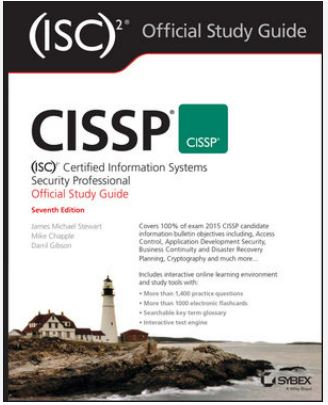
1. (ISC)² CISSP Certified Information Systems Security Professional Official Study Guide
Author: Mike Chapple, James Michael Stewart
Why: Official guide, comprehensive, includes practice questions.
✅ Most popular book for serious CISSP candidates.
2. (ISC)² CISSP Official Practice Tests
Author: Mike Chapple, David Seidl
Why: Offers hundreds of practice questions for all domains. Best for exam simulation.
3. CISSP All-in-One Exam Guide
Author: Shon Harris (updated by Fernando Maymí)
Why: Deep explanation of topics, very detailed. Great for foundational understanding.
4. Eleventh Hour CISSP: Study Guide
Author: Eric Conrad
Why: Ideal for last-minute review. Clear, concise, and exam-focused.
5. CISSP Study Guide
Author: Eric Conrad, Seth Misenar, Joshua Feldman
Why: Easy-to-follow, well-organized, useful for self-paced learners.
6. CISSP For Dummies
Author: Lawrence Miller
Why: Good entry-level book if you’re new to IT security concepts.
🧠 CISSP Domains Summary (Common Body of Knowledge – CBK)
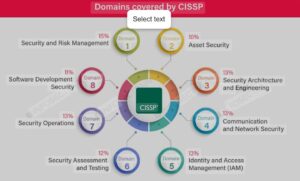
Here’s a summary of all 8 CISSP domains:
🔐 1. Security and Risk Management
Focus: Foundation of security
- Principles of confidentiality, integrity, and availability (CIA triad)
- Risk assessment and management
- Security governance and compliance (laws, regulations, policies)
- Business continuity planning (BCP) & disaster recovery
- Ethics and security awareness training
🔑 Think: “Why security matters and how to manage it.”
🧾 2. Asset Security
Focus: Protecting assets
- Data classification and handling
- Privacy protection
- Secure data storage and retention
- Media sanitization and disposal
🔑 Think: “Classify and secure data properly.”
🧱 3. Security Architecture and Engineering
Focus: Technical design of secure systems
- Secure design principles (least privilege, defense in depth)
- Cryptography (symmetric/asymmetric, hashing, PKI)
- Security models and architectures
- Vulnerabilities in system components (hardware, IoT, cloud)
🔑 Think: “Build systems securely from the ground up.”
🌐 4. Communication and Network Security
Focus: Secure network architecture
- Network protocols and services (TCP/IP, VPNs, firewalls, proxies)
- Secure network components and devices
- Network attacks and defenses (DoS, sniffing, spoofing)
🔑 Think: “How data flows and stays secure in transit.”
👥 5. Identity and Access Management (IAM)
Focus: User and system identity controls
- Identification, authentication, and authorization
- Access control models (RBAC, DAC, MAC)
- Federation, SSO, biometrics, and MFA
- Lifecycle of identities (provisioning, revoking)
🔑 Think: “Who can access what and how.”
🧪 6. Security Assessment and Testing
Focus: Measuring security
- Security audits and assessments
- Vulnerability scanning, penetration testing
- Log reviews, test strategies
- Reporting and metrics
🔑 Think: “Prove security is working (or not).”
⚙️ 7. Security Operations
Focus: Operational practices
- Incident response and investigation
- Logging, monitoring, and SIEM
- Patch and configuration management
- Physical security and personnel safety
- Forensics and e-discovery
🔑 Think: “Daily, practical implementation of security.”
💻 8. Software Development Security
Focus: Secure software lifecycle
- SDLC, DevSecOps
- Secure coding practices (input validation, error handling)
- Threat modeling, code reviews
- Software vulnerabilities (SQL injection, XSS)