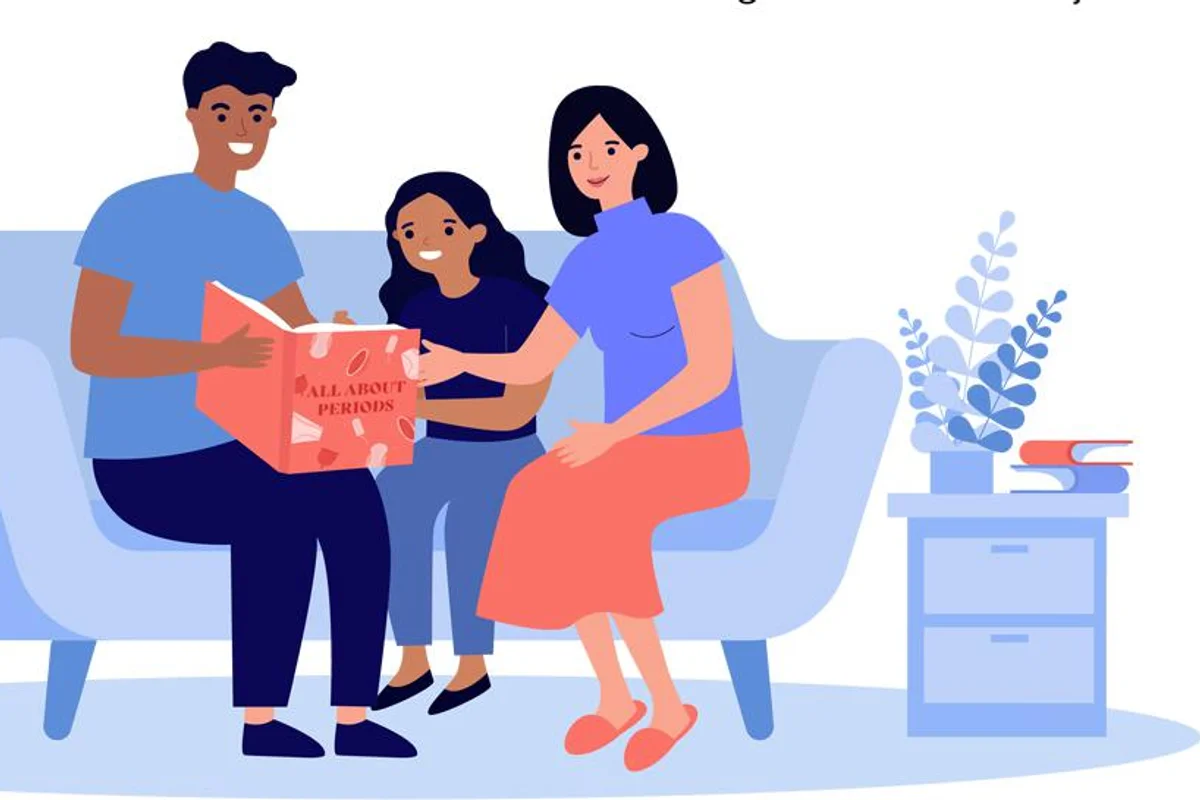
I am going to tell you about how to talk on Menstruation with our kids.
If our children are curious about the dinosaurs, rivers or ocean, we take a lot of effort to talk with them about the things. We get books, puzzles and watch movies together even though they are an extinct species. Periods are something very real, something our daughters will deal with for several decades. It is important to educate our children and build the right perception.
Sanitary Pads
Even if your child is just four or five and questions you about sanitary pads after seeing a television commercial advertisement, don’t change the channel. Explain what a pad is in simple language and with basic, age-appropriate information. You may even give a pad in the child’s hand if he or she is curious. Don’t let them believe that it is a diaper. We think they will be shocked, but that is not the case. They don’t have any preconceived notions. For them, this is just another piece of information. By the age of nine, you should sit down and talk about periods with your daughters. Tell her that this is a biological fact. Tell her there is a uterus which is connected to ovaries by something called fallopian tubes. Tell her about the lining and how it sheds. Also prepare her to handle her period if it starts when she is at school or at a park.
Age Milestone
Menstruation is a milestone that your daughter is reaching to next level of her age. Celebrate it. You can make a first period kit with her. Put in a sanitary napkin, panty liner, underwear, a sweet hand-written letter, a few chocolates and a painkiller if you wish. Teach your daughter whatever is needed, but don’t teach her shame. Remember, if we are ashamed of periods, our daughters will be too. Kids are not born with fear, but they acquire a sense of fear or shame from their parents.
It is important for us to not do that fear and shame and to build a positive legacy. The way you tell your daughter about period determines the way the way of your daughter, granddaughter and great granddaughter are going to experience their first period. You have ability to make sure the experience is pleasant and it begins with a positive note. In fact, we should tell our children how powerful periods are. Our human race propagates because of periods. They are the reason why you and I and everybody came into this world, this is the blood that incubated us in our mother’s womb.
First Experience
In case if you have not yet talk with your daughter and she starts menstruating, don’t worry. You still have chance to talk about it every month. Watch an animation together or simply tell her your story. Tell how you felt when you got your first period, tell her about the time your school uniform got stained. Stories connect women to each other, mother to a daughter or one girl to another. You could also read a book together. ‘My Little Red Book’ which documents ‘First period stories’ from women around the world is a good choice.
Don’t forget to tell your daughter about menstrual pain and teach her to be vocal about it. Tell her there is a glory in suffering pain. Besides, excruciating pain is not normal. If your daughter is complaining about a lot of pain, don’t neglect it, See a gynaecologist as there could be an underlying cause like endometriosis, fibroids or polyester ovaries. On average, girl suffer for seven to eight years before period disorder is detected.
Responsibility of each family members
The period talk is not just the responsibility of mothers, it is nice when the father accompanies the mother or even talks to his daughter by himself. A lot of things are going to happen in teen years from career confusion to heartbreaks, so if this window if parents are supportive, then open that bigger door to equal parents and kids and start to trust on you and tell you what ever they are going through. Don’t forget to educate boys about periods. When we talk to our sons about the chances in their body, be it their voice getting deeper or the growth of facial hair, we should also tell them about what happens to girls. Boys can be very empathetic. Fathers should tell the boys about the time when they went to purchase sanitary pads and make sure they also understand their responsibility about it.